
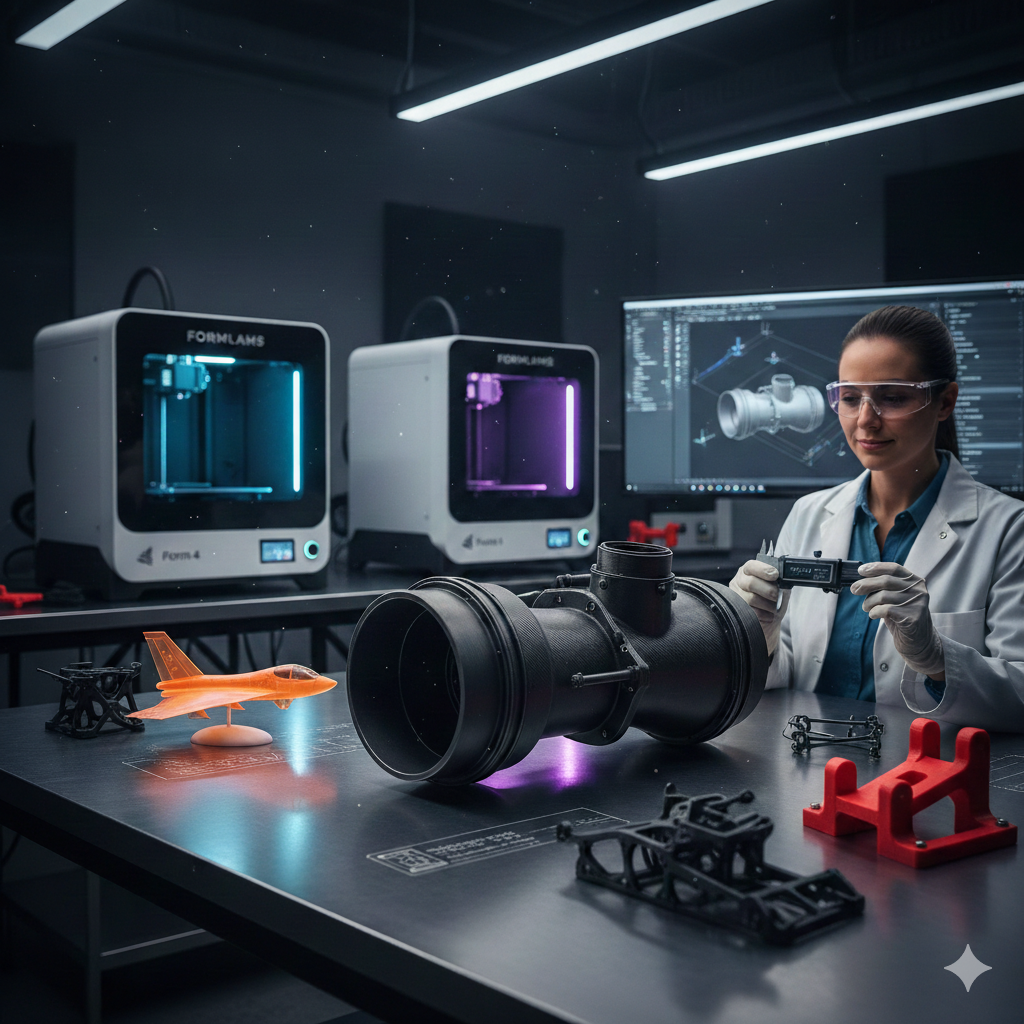
3D printers for aerospace
Aerospace engineering is a field where every second and every gram matters. Engineers in this industry work under intense pressure. They must design parts that are light, strong, and safe. Traditionally, making these parts took a long time. It often required expensive tools and months of waiting. Today, things have changed. Many professionals now turn to 3D printers for aerospace to speed up their work. Formlabs has become a top choice for these experts. Their technology allows for aerospace rapid prototyping right on the desk or in the lab. This change helps teams move from a simple idea to a finished part faster than ever before.
How 3D Printing is Used in the Aerospace Industry
The use of additive manufacturing in aerospace has grown from a niche hobby to a main production tool. In the past, engineers used 3D printing only for basic plastic models. These models showed how a part might look, but they could not be tested. Now, advanced manufacturing for aerospace allows teams to create functional aerospace prototypes. These parts can handle real-world stress, heat, and chemicals.
Aerospace companies use these printers throughout the entire life cycle of a product. During the early stages, they use aerospace prototyping solutions to check if a design fits correctly. Later, they might print 3D printed aerospace components that actually go into an aircraft or a satellite. This process is often called aerospace product development 3D printing. It cuts down the time spent waiting for parts from outside shops. Instead of waiting six weeks for a metal bracket, an engineer can print a high-strength plastic version in six hours.
The Benefits of 3D Printing for Aerospace Engineers
There are many benefits of 3D printing for aerospace engineers. The biggest benefit is speed. In the world of flight, the first company to solve a problem often wins the contract. Using aerospace rapid iteration using 3D printing allows a team to test five different designs in one week. If the first design fails, they learn why and print a better one the next day.
Another major benefit is weight. Lightweight aerospace parts 3D printing is essential because heavier planes and rockets use more fuel. Traditional machines carve parts out of solid blocks of metal. This often leaves behind heavy sections that are hard to remove. A 3D printer only puts material where it is needed. Engineers use “topology optimization” to create hollow but strong shapes. These shapes would be impossible to make with a drill or a lathe.
Why Formlabs is the Best 3D Printer for Aerospace Prototyping
When looking for the best 3D printer for aerospace prototyping, engineers focus on precision and materials. Formlabs offers two main types of printing: Stereolithography (SLA) and Selective Laser Sintering (SLS).
High-Precision 3D Printing Aerospace
The Formlabs SLA printers, like the Form 4, use a laser or light engine to cure liquid resin into solid plastic. This results in high-precision 3D printing aerospace teams rely on for small, detailed parts. The surface of these parts is very smooth. This is perfect for aerospace design validation, where the part must fit perfectly into a larger assembly. If a sensor mount is off by even a fraction of a millimeter, it will not work. Formlabs printers provide the accuracy needed to ensure everything fits the first time.
High-Performance Aerospace Materials
Materials are the secret to Formlabs’ success in this industry. Engineers need more than just basic plastic. They need high-performance aerospace materials that can survive harsh environments.
Rigid 10K Resin: This material is filled with glass. It is extremely stiff and resists heat. It is great for aerospace wind tunnel model printing because it does not bend under high wind speeds.
Flame Retardant Resin: Safety is the number one priority in flight. This resin is UL 94 V-0 certified. It does not catch fire easily and is used for interior cabin parts.
Nylon 12 and Nylon 11 CF: These powders are used in the Fuse series SLS printers. They create rugged, durable parts. Nylon 11 CF is reinforced with carbon fiber, making it ideal for 3D printing for UAV and drone parts.
Solving Problems with Aerospace Tooling and Fixtures
Not every 3D printed part flies on an airplane. A large part of aerospace engineering 3D printing happens on the factory floor. Engineers use aerospace R&D manufacturing tools to help build the aircraft.
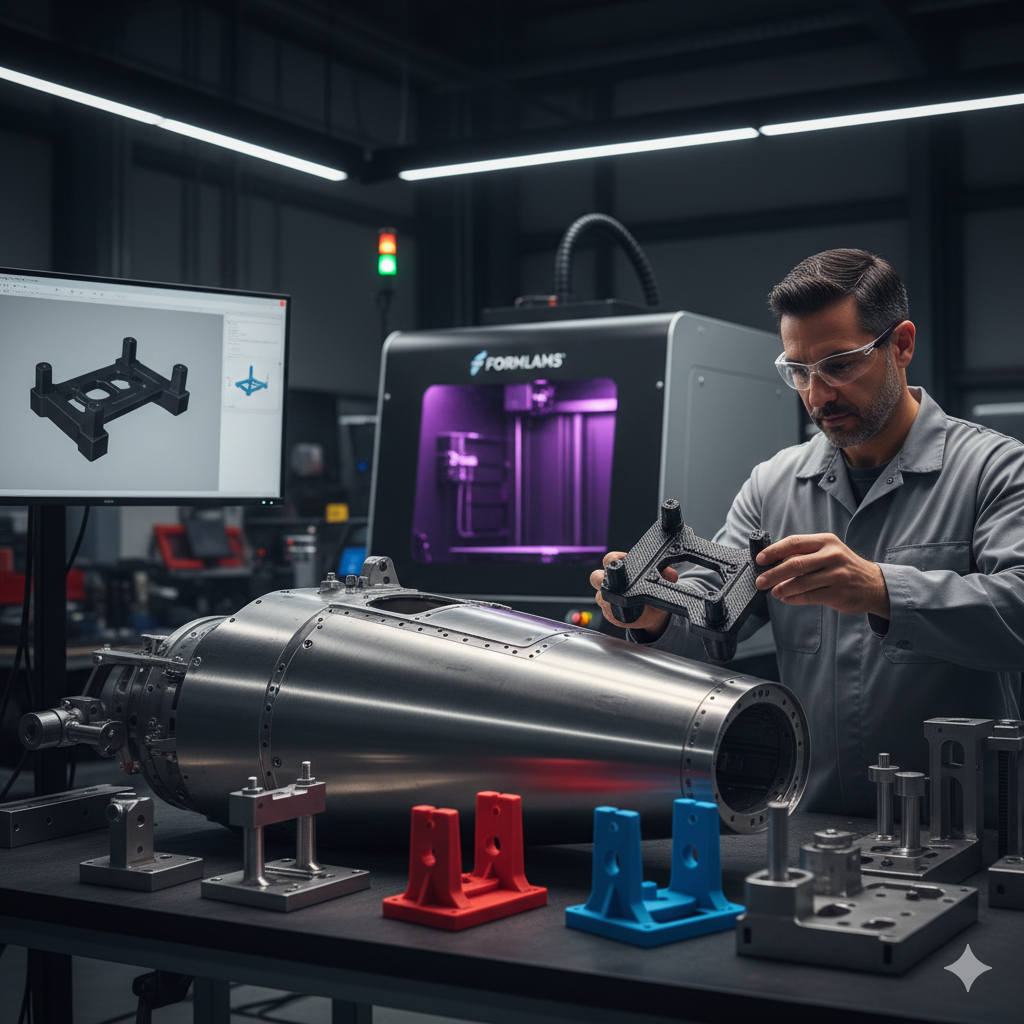
Aerospace Jigs and Fixtures 3D Printing
Manufacturing a jet engine requires thousands of specific tools. These are called aerospace tooling and fixtures. A “jig” helps a worker drill a hole in the exact same spot every time. A “fixture” holds a heavy part steady while it is being worked on. In the past, these tools were made of heavy steel. They were expensive and hard to move.
With aerospace jigs and fixtures 3D printing, companies can make these tools in-house. A 3D printed fixture is much lighter. This makes it easier for workers to handle, which improves safety. If a tool breaks, the team does not have to stop production for weeks. They simply start a new print and have a replacement by the next morning. This is one of the most common ways how aerospace companies use additive manufacturing to save money.
3D Printing for Aerospace Testing
Before a part is allowed to fly, it must go through 1,000 tests. 3D printing for aerospace testing allows engineers to find mistakes early. They can print a model of a wing and put it in a wind tunnel. They can print a fuel tank and test how the liquid moves inside. These aerospace prototyping solutions prevent costly mistakes later in the build process. It is much cheaper to fix a 3D printed model than to fix a full-sized rocket.
Streamlining Aerospace R&D Teams
Research and development (R&D) is where innovation happens. 3D printing solutions for aerospace R&D teams give designers the freedom to try radical new ideas. They no longer have to worry about if a part can be machined. They only care if the part works.
By using 3D printers for aerospace, R&D teams can create “part consolidations.” This means taking five different parts and printing them as one single piece. This reduces the number of bolts and joints in an aircraft. Fewer parts mean fewer things that can break. It also makes the aircraft much lighter and easier to assemble.
Speeding Up the Workflow
Formlabs has designed their ecosystem to be simple. An engineer can learn to use the software and the printer in less than an hour. The software, called PreForm, automatically suggests the best way to print a part. This allows the engineering team to focus on design rather than fixing the printer. This ease of use is why many call it the best 3D printer for aerospace prototyping.
The Future of 3D Printed Aerospace Components
The industry is moving toward more end-use 3D printed aerospace components. We are seeing more drones and small satellites using 3D printed frames. As materials get stronger, we will see even more of these parts in commercial planes.
The goal for every aerospace company is to be agile. They want to react to new data and change their designs quickly. Using 3D printers for aerospace makes this possible. It bridges the gap between a digital computer model and a physical object.
Conclusion
Formlabs has changed the way aerospace engineers think about manufacturing. By providing high-precision tools and industrial-grade materials, they allow for faster innovation. Whether it is creating lightweight aerospace parts 3D printing or building custom aerospace tooling and fixtures, the impact is clear. Companies can now reduce costs, save weight, and get to the launchpad faster.
The ability to iterate rapidly is no longer a luxury. It is a requirement for staying competitive. Formlabs offers the reliability and accuracy that the most demanding engineers need. At Corengg Technologies, we help teams integrate these advanced tools into their daily work. If you want to see how 3D printers for aerospace can transform your next project, we are here to guide you through the process.