
Medical 3D printing
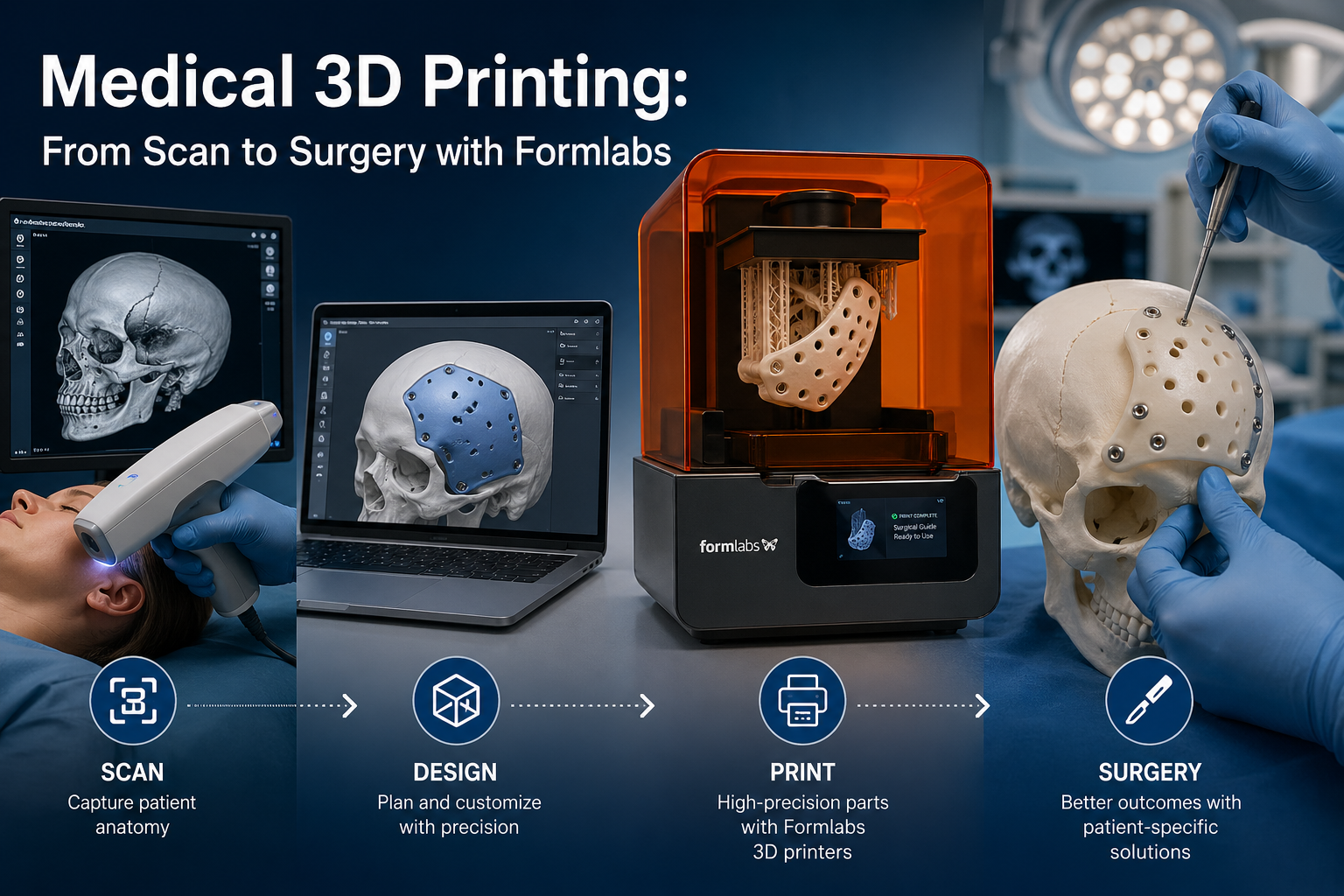
Surgeons today walk into the operating room with more information than ever before. They study a physical model of the patient’s anatomy, rehearse the procedure, and choose the right tools in advance. This is possible because of medical 3D printing. This technology takes digital scan data and turns it into real, touchable objects that help doctors plan and perform complex surgeries with greater precision.
What Is 3D Printing in Healthcare?
3D printing in healthcare means using additive manufacturing to create physical objects for medical use. These include anatomical models, surgical guides, prosthetics, dental appliances, and more. The process starts with digital imaging data such as CT scans or MRI results. Software then converts this data into a 3D file. A printer reads that file and builds the object layer by layer using medical-grade materials.
Hospitals and medical device companies have adopted this approach for several reasons. It allows them to produce highly customized items quickly. It lowers the cost of custom fabrication. It also gives surgeons tools that match the exact anatomy of each patient.
The technology connects two worlds that used to be separate: digital healthcare solutions and physical surgical tools. When these two come together, the result is faster procedures, fewer errors, and better outcomes for patients.
How 3D Printing Is Used in Surgical Planning
Surgical planning 3D printing gives doctors a hands-on view of what they will face during surgery. A CT scan produces hundreds of two-dimensional image slices. Software combines these slices into a 3D digital model. The medical team then sends this model to a 3D printer. Within hours, they have a physical replica of the patient’s organ, bone, or tissue structure.
Surgeons use these models to study the anatomy, measure distances, and choose the best approach. They can practice the procedure before the patient enters the operating room. This reduces surprises during surgery and shortens the time under anesthesia.
The benefits of medical 3D printing in hospitals go beyond planning. Hospitals that print models in-house save time and money. They do not need to send orders to outside vendors and wait days for delivery. They control quality directly. They also improve communication between surgical teams by giving every member a physical object to study and discuss.
Key insight: The medical 3D printing workflow from scan to surgery typically takes 24 to 48 hours for complex anatomical models when printed in-house, compared to 7 to 14 days with traditional outsourcing.
The Role of Formlabs in Modern Medicine
Formlabs is one of the most recognized names in Formlabs medical 3D printing. The company builds high-precision stereolithography (SLA) printers designed for professional use. Their printers are widely used in dental labs, hospitals, surgical centers, and medical device companies around the world.
Formlabs focuses on making professional-grade printing accessible. Their machines fit on a desktop. They do not require a large production floor or a specialized engineering team to operate. This makes Formlabs 3D printing solutions for the healthcare industry practical even for smaller clinics and hospitals.
Formlabs Form 3B: Built for Medical and Dental Use
The Formlabs Form 3B is a biocompatible 3D printer built specifically for medical and dental applications. It uses Low Force Stereolithography (LFS) technology, which delivers smoother surface finishes and higher dimensional accuracy compared to standard FDM printers. This level of precision matters in medicine, where a difference of a fraction of a millimeter can affect how a surgical guide fits or how accurately a model represents the anatomy.
The Form 3B supports a wide range of biocompatible 3D printing materials. These include resins that meet ISO 10993 standards for biological safety. Surgeons and dental professionals can print models, guides, and appliances that can be sterilized and used near or in contact with patients during procedures.
Formlabs Form 3B — Key Medical Features
- LFS Technology: Produces smooth surfaces with fine detail, critical for accurate anatomical models
- Biocompatible Resins: Materials certified safe for short-term skin and mucosal contact
- Compact Footprint: Fits in a clinical lab without dedicated manufacturing space
- Validated Workflow: Integrates with dental and medical CAD software for a seamless digital pipeline
- Open Material Platform: Supports third-party biocompatible resins for expanded use cases
Creating Patient-Specific Surgical Models Using 3D Printing
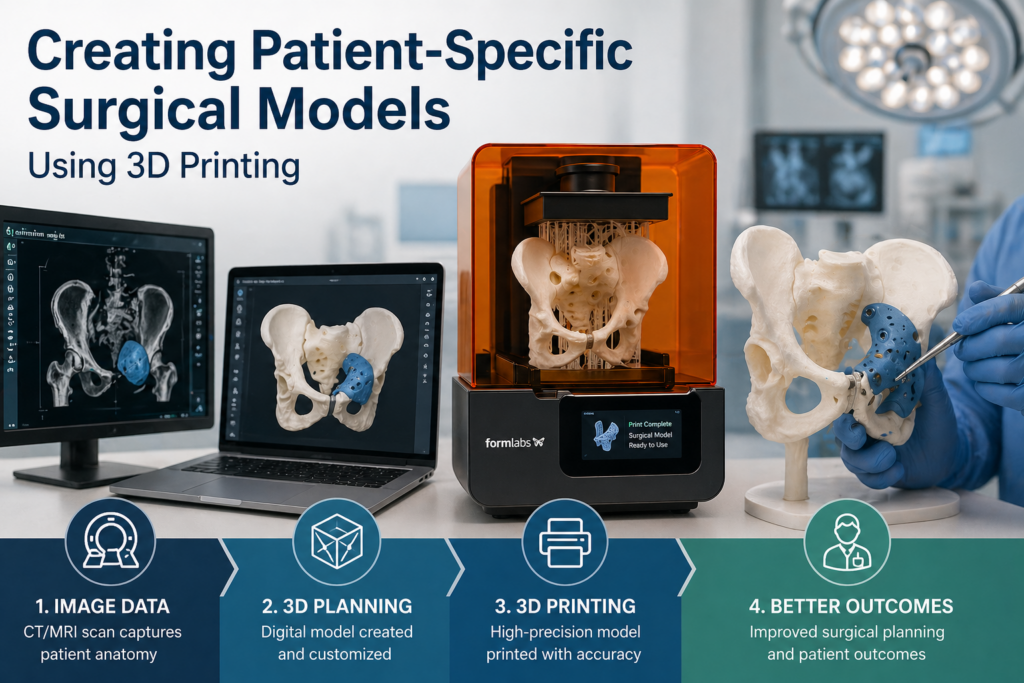
Patient-specific 3D printing is one of the most impactful uses of this technology in medicine. Every person’s body is different. A generic model or standard guide may not work well for a patient with unusual anatomy or a complex condition. With 3D printing, medical teams can create objects that match one specific person exactly.
The process of creating patient-specific surgical models using 3D printing follows a clear path. It starts with imaging and ends with a printed object ready for use in surgical planning or intraoperative guidance.
Acquire Imaging Data
The clinical team captures a CT scan or MRI of the patient’s anatomy at the relevant site.
Segment and Process the Data
Segmentation software isolates the structure of interest, such as a tumor, bone, or vessel. It converts the DICOM data into a printable 3D file format like STL or OBJ.
Prepare the Print File
The team reviews the file in slicing software, selects the right material, and sets print parameters for accuracy and resolution.
Print the Model or Guide
The Formlabs printer builds the object layer by layer using the selected biocompatible resin.
Post-Process and Sterilize
The printed part is washed, cured, and sterilized if required for clinical use.
Use in Planning or Surgery
Surgeons study the model, practice the procedure, and use 3D printed surgical guides intraoperatively to improve accuracy.
The Role of SLA 3D Printing in Modern Medicine
SLA 3D printing in medicine stands apart from other methods because of its accuracy and surface quality. SLA uses a UV laser to cure liquid resin layer by layer. This produces parts with very fine detail and smooth surfaces. In medical use, this matters for several reasons.
First, anatomical models need to represent real tissue accurately. A rough or inaccurate model can mislead surgeons during planning. SLA printing achieves resolutions as fine as 25 microns, which is sufficient for capturing small blood vessels, nerve pathways, and thin bone walls.
Second, surgical guides need to fit precisely on bones or teeth. A poorly fitting guide shifts the planned cut or implant position. SLA parts hold tight dimensional tolerances that make guides reliable and repeatable.
Third, dental and medical applications of 3D printing often require smooth, polished surfaces for patient comfort and hygiene. SLA-printed parts require less post-processing sanding than FDM alternatives.
Formlabs has built its Form 3B around these requirements. The printer’s LFS technology applies a flexible tank system that reduces peel forces during printing. This results in less stress on the part during production and a higher success rate for thin-walled or delicate geometries common in medical prototyping solutions.
Use of 3D Printed Anatomical Models in Complex Surgeries
The use of 3D printed anatomical models in complex surgeries has grown rapidly across specialties. Orthopedic surgeons use bone models to plan joint replacements and trauma repairs. Neurosurgeons use skull and brain models to map tumor removal paths. Cardiovascular teams use heart and vessel models to plan stent placements or valve repairs. Maxillofacial surgeons use jaw and facial models to plan reconstructive procedures.
In each case, the model allows the team to study the anatomy in three dimensions without working directly on the patient. This is especially valuable when the anatomy is unusual, distorted by disease, or difficult to visualize from scans alone.
Pre-surgical planning tools like these also improve communication with patients. A surgeon can show a patient a physical model of their own anatomy and explain the planned procedure clearly. This builds trust and improves informed consent discussions.
Clinical example: In complex spinal surgeries, teams that used patient-specific models and 3D printed surgical guides reported fewer intraoperative adjustments and lower rates of implant malpositioning compared to standard imaging-only planning.
3D Printed Surgical Guides: Precision at the Point of Care
3D printed surgical guides are one of the most direct applications of this technology. A surgical guide is a physical template that a surgeon places on a patient’s anatomy during a procedure. It directs the placement of drills, screws, implants, or cuts to the exact planned position.
Without a guide, the surgeon relies on visual landmarks and experience to hit the correct position. With a guide, the position is predetermined and locked in by the shape of the tool. This improves accuracy, especially in dense anatomical areas where errors have serious consequences.
How Formlabs improves surgical accuracy with 3D printing comes down to three factors. The printer’s high resolution captures the exact contours of the patient’s bone surface. The biocompatible resin withstands sterilization without warping. The validated workflow from imaging software to print file reduces errors at every step of data transfer.
Orthopedic and dental surgeries have benefited the most from this approach. In dental implant surgery, 3D printed guides help position implants at the planned angle and depth. This shortens surgery time and improves outcomes for patients.
Advantages of In-House 3D Printing for Hospitals
The advantages of in-house 3D printing for hospitals are practical and financial. When a hospital operates its own printer, it gains control over the entire process. Turnaround time drops from days or weeks to hours. The team can iterate on a model and reprint it quickly if the first version is not ideal.
Cost is another factor. Cost-effective 3D printing solutions for medical applications become possible when hospitals bring the technology inside. They eliminate vendor markups, shipping fees, and outsourcing delays. The material cost per model is far lower than traditional manufacturing or outsourced fabrication.
Workflow automation in hospitals also improves when 3D printing is integrated into the digital imaging pipeline. Segmentation software connects directly to the printer. The steps from scan to physical model require less manual intervention over time. Staff spends less time coordinating external vendors and more time supporting clinical work.
Personalized medicine technology advances when clinicians have on-demand printing capability. They can produce a custom model for every complex case, not just the ones that justify the cost and delay of outsourcing. This raises the standard of care across more patients.
Precision healthcare tools produced in-house also allow for faster research and innovation. Medical teams can test new guide designs, create training models for surgical residents, and develop new protocols without waiting on external suppliers.
Dental and Medical Applications of Formlabs Technology
Formlabs serves two closely related markets: dental and medical. Both require high precision, biocompatible materials, and reliable workflows. The Form 3B handles both with a single platform and a library of validated resins.
In dental settings, Formlabs printers produce clear aligners, surgical guides for implant placement, crown and bridge models, denture bases, and retainers. These are applications where accuracy directly affects patient fit and comfort. A poorly fitting dental guide can misdirect an implant drill. A warped denture base will not seat correctly.
In medical settings, the applications extend to orthopedic models, cardiovascular planning models, craniofacial reconstructions, and educational anatomy models for medical schools. Each of these requires the same foundation: precise geometry, biocompatible materials, and a reproducible print process.
Healthcare innovation technology from Formlabs supports this range of applications through regular material updates. The company continues to develop new resins for specific clinical needs, including high-temperature resins for autoclave sterilization and flexible resins for soft-tissue models.
What the Future Holds for 3D Printing in Healthcare
The future of 3D printing in healthcare points toward greater integration with digital health platforms. As imaging software becomes more automated, the path from scan to printed model will require less manual work. AI-assisted segmentation will make it easier to isolate anatomical structures quickly and accurately.
Bioprinting, which uses living cells as printing material, represents the next frontier. Researchers are already printing tissue scaffolds and, in some cases, functional tissue for research use. While implantable bioprinted organs remain years away from clinical use, the foundational technology builds on the same principles that make today’s anatomical modeling possible.
Digital healthcare solutions will increasingly treat 3D printing as a standard part of the surgical workflow rather than a specialty service. Hospitals that invest in this capability now build a competitive advantage in surgical outcomes and patient care.
Material science will also advance. New biocompatible resins will expand what can be printed and how it can be used clinically. Antimicrobial materials, drug-eluting scaffolds, and resorbable implant guides are already in various stages of research and regulatory review.
Conclusion
Medical 3D printing has moved from a research novelty to a clinical standard in many hospitals. Formlabs technology plays a central role in making this shift practical for institutions of all sizes. From surgical planning to in-room guides, the workflow from scan to surgery is now faster, more accurate, and more personalized than ever before.
The benefits are clear: fewer complications, shorter procedures, better patient communication, and lower costs for custom fabrication. Hospitals that adopt in-house 3D printing gain a tool that improves nearly every step of complex surgical care.
If your organization wants to explore Formlabs 3D printing solutions for healthcare, Corengg Technologies is here to guide you. As an authorized Formlabs reseller serving hospitals, dental labs, and medical institutions across South India and Pune, we help you evaluate, implement, and support the right 3D printing setup for your clinical needs. Reach out to our team to learn how we can help you bring this capability in-house.